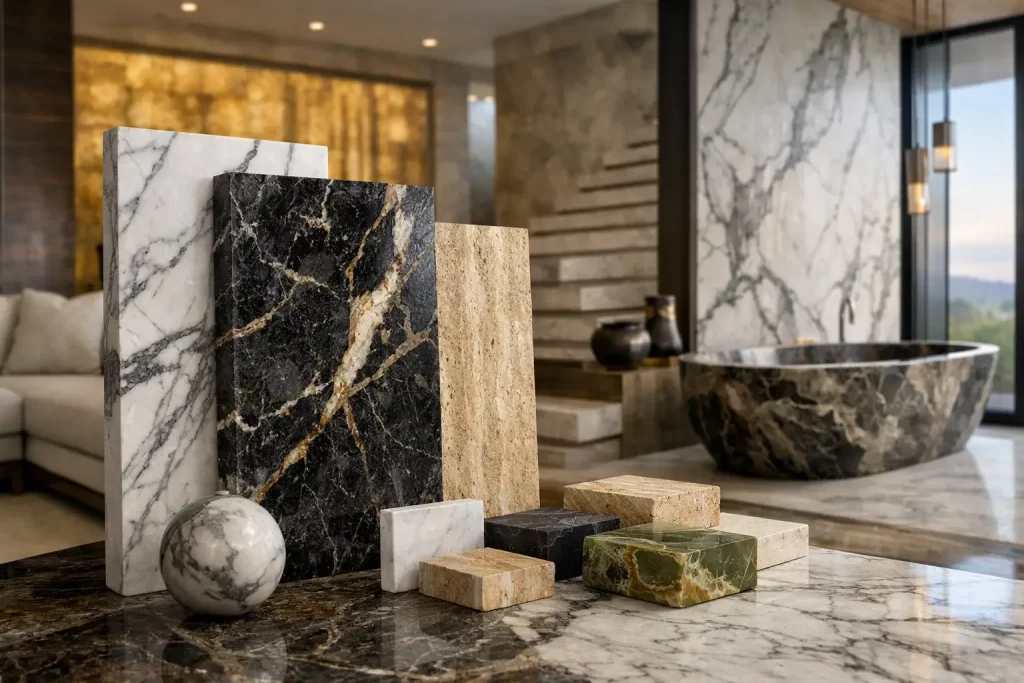
The costliest stone mistake in a luxury project usually begins when the material still looks perfect on paper. A credible Stone Sourcing Strategy for Luxury Projects is not about finding something beautiful. It is about protecting material intent against climate, logistics, aging and the commercial pressure that arrives later.
Why stone sourcing strategy matters upstream
In ultra-luxury residential and boutique hospitality work, stone is often treated as a finish decision. That is precisely where projects become vulnerable. The real question is not whether a stone suits the rendering or sample board. It is whether it can sustain the architectural ambition of the project once exposed to salt air, humidity, heat, maintenance realities and long import routes.
A stone that appears exceptional in a design presentation may become visually unstable, difficult to maintain or inconsistent in delivered character. In import-dependent island and coastal developments, there is rarely a convenient second chance. Once direction is set, alternatives are limited and corrections become expensive, visible and reputation-sensitive.
The hidden risk in luxury stone decisions
Luxury coherence depends on more than rarity or price. It depends on judgment. Stone must belong to the project as a whole – to its architecture, its location, its pace of wear and the standard of ownership or hospitality it promises.
This is where many teams underestimate the issue. Suitability is contextual. The right material for a temperate private residence may be the wrong one for a Gulf beachfront villa or a remote Indian Ocean resort. Longevity is not an abstract virtue here. It shapes guest perception, maintenance burden and whether the property still feels composed years after completion.
Stone Sourcing Strategy for Luxury Projects and long-term value
The most successful projects treat stone as an asset decision. They understand that timelessness is rarely accidental. It comes from alignment between appearance, resilience and supply reality.
When that alignment is absent, the damage is rarely confined to one surface. It spreads into inconsistency between areas, compromised substitutions, avoidable maintenance issues and a gradual loss of confidence in the finished environment. For luxury projects, that erosion affects more than appearance. It affects perceived quality and investment position.
Independent advisory changes the conversation because it removes the pressure to make stone fit a sales agenda. Stonari approaches sourcing from the standpoint of material integrity, logistical reality and long-term coherence – not supplier inventory.
The better question is not, Which stone looks right today? It is, Which stone will still feel inevitable once the project has crossed distance, climate and time?
Approaching a significant stone sourcing decision?