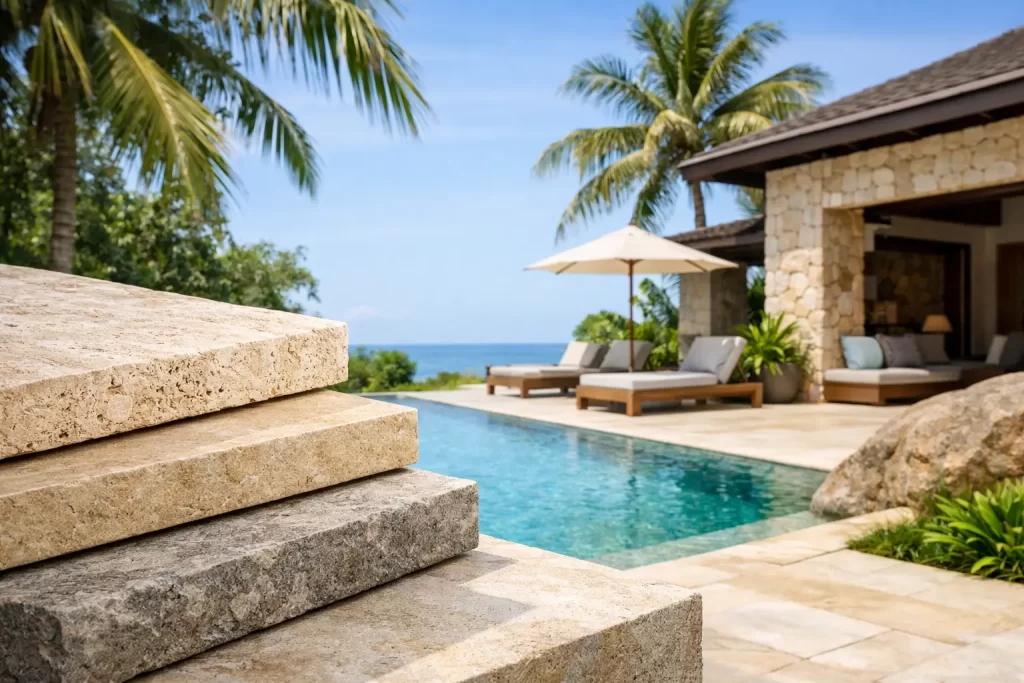
The expensive mistake is thinking tropical projects simply need a harder stone. They do not. Natural Stone for Tropical Climate Projects is rarely decided by strength alone. In luxury residential and boutique hospitality work, the real question is whether the material can hold its visual authority, aging character, and technical suitability under conditions that expose every weak assumption.
Why Natural Stone for Tropical Climate Projects Fails Early
Tropical climate is not a single condition. Heat, humidity, salt exposure, intense rainfall, shaded exterior zones, pool adjacency, and import dependency create a far more complex reality than most design narratives acknowledge. A stone that appears convincing in a temperate showroom can become visually unsettled, operationally burdensome, or simply out of place once translated into a coastal villa or island resort.
This is where many costly problems begin. The failure is often upstream, long before installation. A beautiful material may still be wrong for the architectural language, the maintenance tolerance of the asset, the rhythm of occupancy, or the logistical constraints of a remote destination. When that misalignment is built into the specification, the project inherits it permanently.
Longevity Is a Luxury Decision
In tropical environments, poor stone judgment rarely announces itself immediately. It appears over time through uneven aging, tonal inconsistency, surface instability, maintenance frustration, or a gradual loss of refinement. That matters because in high-value property, material performance is inseparable from brand perception, resale confidence, and guest experience.
The best outcomes feel calm because the stone continues to make sense years later. It belongs to the setting. It supports the architecture rather than competing with climate. It weathers with dignity. That kind of coherence is not decorative. It protects intent.
Context Matters More Than Preference
The most sophisticated stone programs are not driven by isolated preference or trend. They are shaped by context – geographic, architectural, operational, and commercial. A stone selection that elevates a city residence may introduce unnecessary vulnerability in the Gulf, East Africa, or an Indian Ocean island development where lead times are long and fallback options are limited.
That is why independent judgment matters. Not every visually compelling stone is suitable, and not every suitable stone will preserve the level of luxury a project is trying to express. The decision sits at the intersection of resilience, appearance, supply reality, and long-term coherence.
For STONARI, this is the essential reframe: stone is not a finish package decision. It is an asset decision. And in tropical work, the most important question is not whether the stone looks right today, but whether it will still feel inevitable when the climate has had time to speak.
Working on a natural stone project in a tropical or coastal environment?