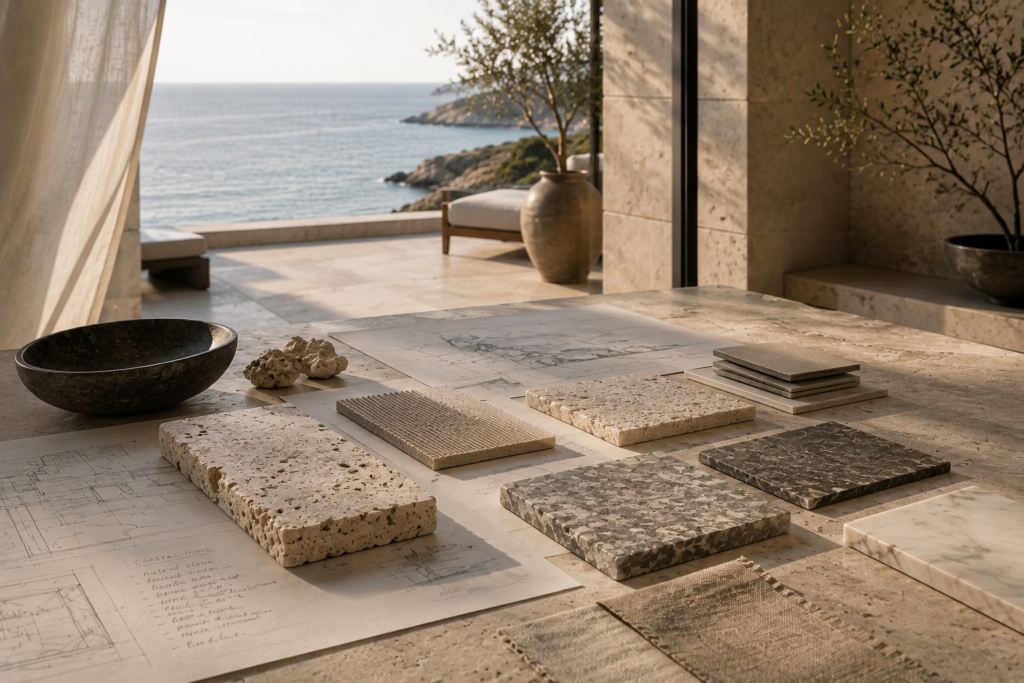
Salt air rarely announces failure early. A stone terrace can look impeccable at handover, only to show edge breakdown, uneven weathering or persistent staining after one wet season. In coastal construction, that gap between first impression and long-term performance is exactly why stone specification for coastal homes cannot be treated as a late-stage finish decision.
For luxury residential projects, the stakes are higher than maintenance inconvenience. The wrong stone can compromise market positioning, dilute architectural intent and create expensive remedial work in locations where replacement is slow, disruptive and sometimes practically impossible. Coastal environments are unforgiving, but they are not unpredictable. Most failures begin upstream, when aesthetic selection outruns technical judgment, climatic reality or supply chain discipline.
Why stone specification for coastal homes is a strategic decision
At the high end of the market, natural stone does more than complete a palette. It influences perceived permanence, quality and value. On a beachfront villa or remote island residence, stone is often used across terraces, pool surrounds, staircases, cladding, bathrooms and transition spaces where indoor and outdoor living merge. That level of exposure means specification decisions affect not just appearance, but slip resistance, heat behavior, maintenance burden and replacement risk.
Coastal settings intensify every weakness. Salt crystallization, wind-driven rain, high UV exposure, elevated humidity, thermal movement and airborne contaminants all act on the material simultaneously. A stone that performs well in a temperate inland home may be a poor candidate on an ocean-facing site. The issue is not whether a stone is premium, rare or visually compelling. The issue is whether its geological characteristics, finish, fabrication details and sourcing model align with the environment it will actually face.
This is where many projects lose control. Stone is sometimes approved before its natural variability and project context are fully considered. By the time concerns surface, the material may already be allocated, fabricated or in transit.
The material question is not simply hard versus soft
A common oversimplification in stone specification for coastal homes is to reduce performance to hardness alone. Hardness matters, but it is not enough. Some dense stones still react poorly to salt-rich moisture cycles. Some stones with attractive open textures can become chronic maintenance liabilities in exposed exterior zones. Even within the same commercial category, variation can be more significant than it first appears.
Suitability depends on context. Materials that appear visually or commercially aligned with a project are not always appropriate for the realities of use, setting and long-term performance.
The real question is not whether a stone is appropriate in theory, but whether it is appropriate in context. Without sufficient precision, specifications risk remaining conceptual rather than executable.
Exposure mapping should happen before final selection
Not every part of a coastal property experiences the same risk. Ocean-facing hardscape, shaded outdoor showers, covered loggias, internal wet rooms and feature walls all place different demands on the material. Yet projects routinely attempt to carry one stone language across all these conditions for visual continuity.
The ambition for continuity is understandable, but successful material schemes balance consistency with context. In many cases, preserving a coherent visual identity produces a stronger result than insisting on absolute uniformity.
When project realities are clearly understood, material decisions become more intentional, disciplined and aligned with long-term project goals.
Finish selection is where many avoidable failures begin
Finish selection is often underestimated. In coastal and high-performance environments, it shapes not only visual character but also how a material is experienced and maintained over time. What appears compelling in a sample may behave very differently in real conditions.
The strongest outcomes emerge when finish selection is considered in relation to the realities of the project rather than aesthetics alone. When material decisions are evaluated in context, projects tend to age more gracefully, perform more reliably and preserve their intended identity over time.
Logistics can make a technically good stone a commercially bad decision
Logistics can make a technically appropriate stone a commercially difficult decision. Material suitability alone does not guarantee project suitability, particularly in import-dependent or remote environments where continuity, timing and execution carry greater consequence.
In these contexts, disruptions can become costly quickly, limiting flexibility and increasing pressure on decision-making. The earlier those variables are considered, the more optionality and control a project tends to retain.
This is where independent advisory becomes particularly valuable. Project decisions benefit from objective judgment focused on long-term outcomes rather than short-term material availability.
What high-value teams should verify before approval
A serious stone program evaluates more than appearance or cost. The relevant question is not simply whether a material is desirable, but whether it is genuinely suited to the ambitions, realities and long-term expectations of the project.
This does not mean every project requires the most conservative choice. Some clients intentionally prioritize atmosphere, character or visual effect, accepting the implications that may come with them. The important distinction is whether those decisions are made consciously and in alignment with project goals.
Sophisticated specification is not about eliminating character. It is about aligning expectation, context and outcome before meaningful commitments are made.
The best coastal homes treat stone as part of asset protection
In prime residential markets, materials communicate permanence, seriousness and quality long before technical considerations are discussed. That perception, however, depends on how convincingly a material ages over time. Premature deterioration is rarely perceived as character; more often, it is read as compromised judgment.
For this reason, the strongest projects treat stone as an asset decision rather than a styling decision. In demanding environments such as a coastal setting, material choices benefit from being approached with realism as much as aesthetic ambition, particularly where replacement is complex and project expectations are high.
A powerful stone identity is absolutely possible in coastal architecture, but it depends on decisions that remain credible over time. On high-value residential and boutique hospitality projects, stone is rarely only aesthetic. It influences longevity, perception, project confidence and the integrity of the broader design vision. Once decisions are made too late, flexibility narrows and compromises become more expensive.